

Concrete products · Practical application guide
Concrete products. Dosage & mixing.
Use a weighed 0/2/3/4% comparison, select the right charging route, and diagnose color differences before changing the formula.
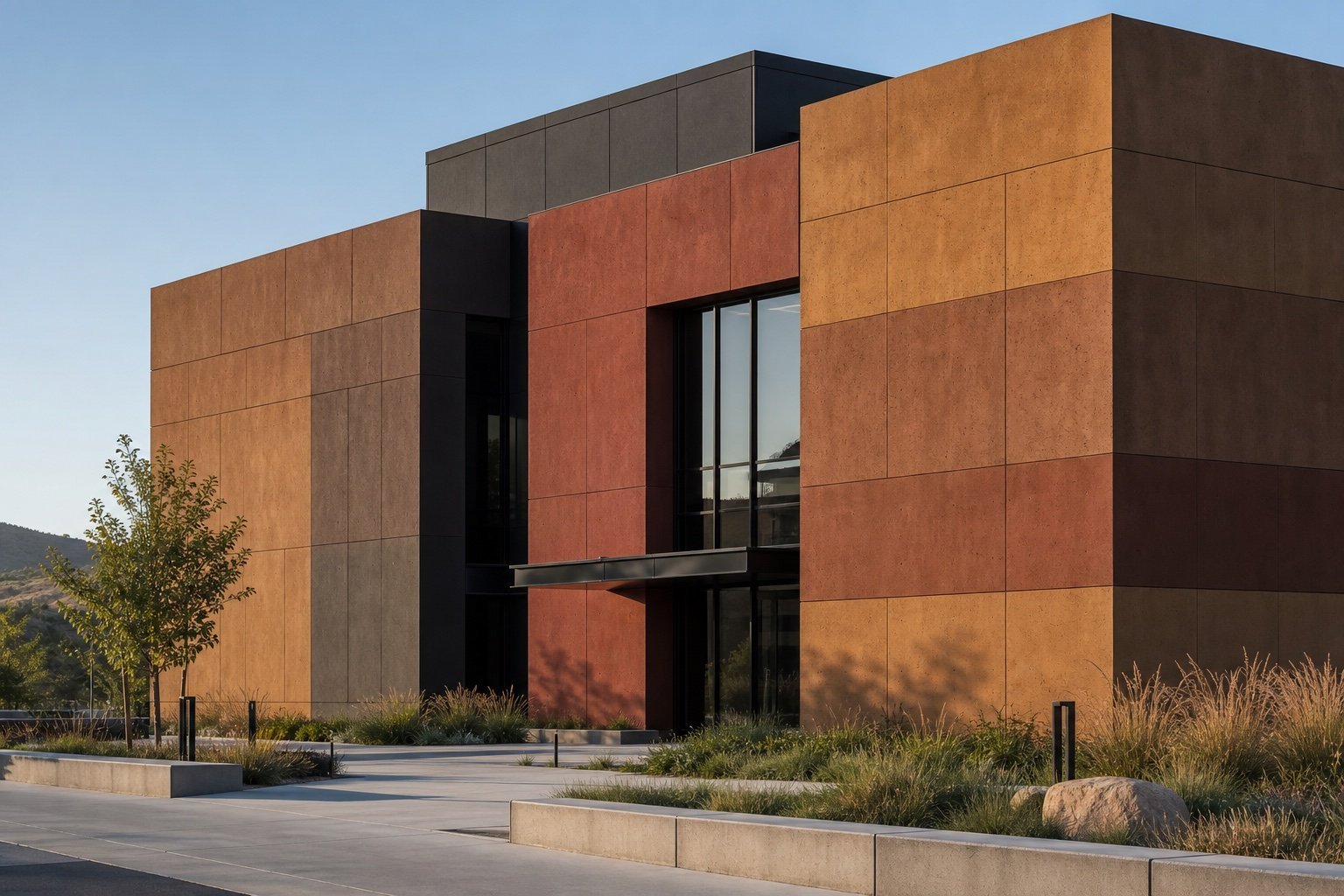
Choose a useful pigment ladder
For an ordinary cement-based concrete trial, compare an uncolored control with 2%, 3% and 4% dry pigment by total cementitious mass, provided the selected grade permits this window. This exploratory ladder follows Solomon’s stated 2–4% range for its dry integral concrete colors. It is not a FUXIN specification or a complete concrete mix design. The same sheet reports a 7% saturation point for its products; that is a reason to check diminishing returns, not a target. Official dosage reference
Use the existing qualified base concrete. Keep its cement, additions, aggregate and admixtures fixed during the first comparison. Pressed units and wet-cast products need separate production trials.
Calculate each batch before weighing
Dry pigment mass = reference cementitious mass × dosage ÷ 100. For this table, the reference contains cement plus the specified cementitious additions, excluding aggregate and water. Pigment is additional material; do not remove the same mass of cement.
| Separate trial | Pigment rate | 5 kg reference binder | 20 kg reference binder |
|---|---|---|---|
| Control | 0% | 0 g | 0 g |
| A | 2% | 100 g | 400 g |
| B | 3% | 150 g | 600 g |
| C | 4% | 200 g | 800 g |
A batch with 16 kg cement and 4 kg qualifying cementitious addition has a 20 kg denominator. At 3%, weigh 600 g pigment. The table does not prescribe a cement-to-aggregate ratio, water content or structural strength. If the pigment instructions use cement alone, recalculate with that denominator instead of silently changing the basis.
Use a charging route that matches the equipment
- Clean the mixer, especially after a dark color. Confirm the batch size and tare the pigment container. Label the control and candidate moulds before starting.
- For dry-powder or granular masonry production, Davis documents an aggregate-plus-pigment premix of 30 seconds, followed by cement and water. Treat this as one reference route to verify in the plant; the same guide lists alternatives. Masonry mixing sequences
- Add the remaining ingredients according to the qualified concrete procedure. Keep the total water calculation, loading and cycle consistent. Record premix and wet-mix durations separately.
- For Solomon repulpable ready-mix bags, the cited instruction is at least 100 revolutions and 10 minutes. That is a different packaging/equipment route and must not become a bench-mixer timer. Ready-mix bag instructions
- Inspect the discharged mix and cast representative specimens. Do not add water merely because one colored candidate looks stiffer; measure and investigate the change.
Separate pigment effects from forming effects
Use one forming method for the initial color series. For pressed products, record the vibration/compaction program and fill mass. For cast products, identify the mould face, release agent and placement method. Make a second independent batch of the preferred candidate. A repeat batch tests whether the result can be reproduced; several specimens from the same batch do not answer that question.
Keep one untreated sample and finish its companion exactly as production will be finished. Compare corresponding faces after the same cure and conditioning. Grinding or exposing aggregate changes the visible balance between matrix and grains. Precast finish effects
Use a simple acceptance sheet
Record the sample ID, pigment lot and grams, actual binder masses, moisture correction, total added water, mixer load, cycle, forming settings and cure. On the assessment date, note age, moisture condition, lighting, finish and any sealer. Compare control, A/B/C and the repeated selected batch together. If the extra pigment from B to C barely changes the dry result, weigh its cost against the improvement before increasing further. Confirm the specified fresh and hardened concrete tests for the selected mixture.
Symptoms, checks and corrective trials
| Symptom | Likely checks | Next controlled action |
|---|---|---|
| Whole batch lighter | Binder lot, water correction, drying condition | Repeat with matched materials and conditioning |
| Dark dots or streaks | Clumps, mixer residue, incomplete dispersion | Clean and compare a verified charging cycle |
| Color differs by mould face | Release, leakage, face finish | Cast paired pieces with controlled mould preparation |
| White surface haze | Efflorescence versus other discoloration | Diagnose deposit before changing pigment |
These checks identify the next experiment, not a diagnosis from a photograph. NRMCA distinguishes several discoloration mechanisms. Discoloration background Send FUXIN the selected dry sample, recipe sheet and repeated-batch results when requesting a grade match or quotation.
Technical references
- Solomon Colors: Dry Integral Colors, dosage and ready-mix instructions
- Davis Colors: Manufacturing Colored Concrete Masonry
- NPCA: Coloring Precast Concrete
- NRMCA: CIP 23, Discoloration
Independent technical guidance used for this application overview. These references are not FUXIN project case studies or a substitute for a grade-specific technical data sheet.