

Terrazzo floor · Practical application guide
Cement terrazzo. Color & grinding.
Calculate pigment against the cement matrix and judge it only after the actual chip exposure, filling and polish are complete.
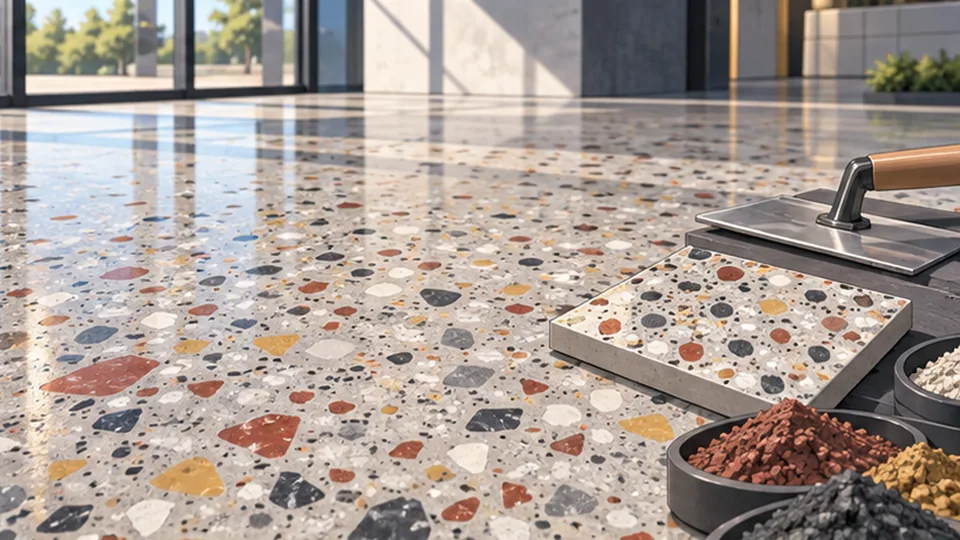
Confirm that the matrix is cementitious
This guide concerns cement terrazzo. Epoxy terrazzo uses a resin-controlled formulation and cannot inherit these cement-based ratios. Identify the specified terrazzo assembly, substrate, joints and finishing system before making color samples. The pigment colors the matrix around the chips, so the final result depends on matrix shade, chip selection and how much aggregate grinding reveals.
Use a documented cement-and-chip reference
NTMA’s monolithic-terrazzo guide specification, revised June 2015, gives 94 lb Portland cement per 150 lb marble chips, with pigment if required and enough potable water for workable consistency. This is a reference for that terrazzo system, not a universal recipe for thin overlays or other terrazzo constructions. NTMA mix provisions, page 10
Scaling only those dry proportions gives 10 kg cement plus approximately 15.96 kg chips. Water must follow the selected system and aggregate condition; the reference does not provide a fixed water ratio. Do not invent one from the dry proportions.
| Chip-blend calculation example | Fraction of 15.96 kg chips | Mass |
|---|---|---|
| Chip A | 60% | 9.58 kg |
| Chip B | 40% | 6.38 kg |
| Total | 100% | 15.96 kg |
The 60:40 combination is a proposed sample blend, not an NTMA color formula. Keep it fixed while evaluating matrix pigment, then change chip proportions in a separate series.
Calculate pigment on the selected binder basis
Suppose the approved pigment candidate is 3% of cement mass. With the 10 kg cement sample, weigh 300 g dry pigment. Do not calculate 3% of cement plus chips: that would give approximately 779 g, a substantially different formulation. Construction-pigment guidance uses defined cementitious denominators, so the recipe must identify which one applies. Pigment dosage context
For a trial comparison, weigh an uncolored control and supplier-approved lower and higher loadings around the selected candidate. Record white or gray cement, chip grading, pigment grade and all actual masses. If you change from gray to white cement for a cleaner pastel, make a new complete sample rather than assuming the previous pigment dose will match.
Cast, grind and fill before approving color
- Blend the weighed chips, cement and pigment through the chosen system’s mixing procedure, then add measured water. NTMA’s cited sequence mixes dry components before adding water. Mixing sequence
- Cast a labeled sample that can be finished by the intended equipment. Use the planned compaction and curing procedure. Keep enough samples to compare different finishing choices without losing the unmodified reference.
- Grind to the specified aggregate exposure. Record the sequence and photograph the surface before filling. A different exposure can appear to be a color change.
- Fill pores using the approved matching grout. Calculate its color against its own binder mass; do not assume the main terrazzo’s whole-mix percentage applies. For an already approved 3% binder-based filling recipe, 500 g binder would require 15 g pigment.
- Complete the final polish and protective treatment. Mark treated and untreated references so later comparisons remain meaningful.
Evaluate matrix and chip distribution separately
NTMA distinguishes several terrazzo systems and their intended construction. Keep the chosen system’s requirements for thickness, bond and use separate from color approval. System reference
| What changed | Check before adjusting pigment |
|---|---|
| Overall sample looks lighter | Greater white-chip exposure or different polish |
| Small colored fill marks | Pore-filling grout recipe and finishing |
| Uneven chip distribution | Mixing, placement and compaction |
| Chips pull out during grinding | Cure readiness and matrix integrity |
| Sealed sample is darker | Treatment effect on the complete finish |
Approve the fully dried, finished sample in the project lighting. Keep the chip blend, matrix recipe and polishing record together; a powder color number alone is insufficient for later repairs. Send FUXIN that record and the preferred sample when requesting a matching pigment grade.
Technical references
- NTMA: Monolithic Terrazzo specification
- Davis Colors: Powder pigment product data
- NTMA: Terrazzo Systems Reference Guide
Independent technical guidance used for this application overview. These references are not FUXIN project case studies or a substitute for a grade-specific technical data sheet.