

Cultural stone · Practical application guide
Manufactured stone. Color & mould trials.
Build a controlled light-to-dark palette, calculate body and facing doses separately, and inspect real textured units.
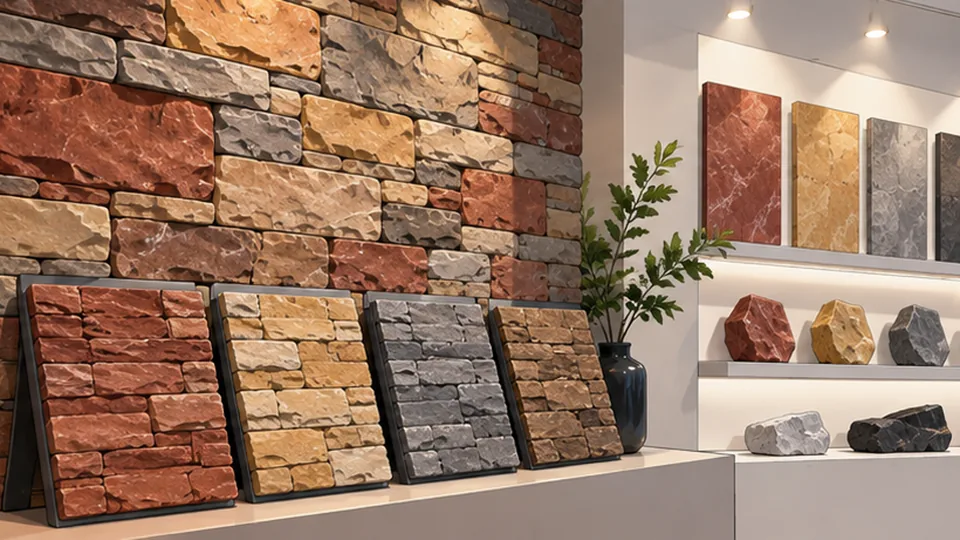
Define the product behind “cultural stone”
Here the term means cement-based manufactured stone veneer: thin decorative units that reproduce stone texture. CMHA describes these products as combinations of cement, aggregates, additives and color pigments. Its guide specification treats product qualification and installation as separate requirements. This page addresses factory color development, not the design of the adhered wall assembly. Verify the unit system and intended exposure before choosing a pigment. CMHA: Adhered Manufactured Stone Veneer Guide Specification
Select a bounded body-color trial
Fishstone identifies 1–4% of total cementitious mass as common for architectural concrete using its pigments, including cast-stone applications. A control plus 1%, 2% and 4% is therefore a useful proposed screening ladder when the selected grade and veneer system allow it. It is not a veneer certification or a FUXIN dosage guarantee. Supplier dosage context
A natural-looking palette need not mean uncontrolled pigment additions. Develop and name separate light, medium and dark recipes. Keep the individual pigment masses, not merely the final shade names.
Calculate the body and face materials correctly
| Trial material | Declared cementitious mass | 1% | 2% | 4% |
|---|---|---|---|---|
| Body-color bench batch | 5.00 kg | 50 g | 100 g | 200 g |
| Separate facing batch | 1.00 kg | 10 g | 20 g | 40 g |
| Larger body batch | 25.00 kg | 250 g | 500 g | 1,000 g |
These are dry-pigment masses from percentage × binder mass. Exclude lightweight aggregate, sand and water. Include only ingredients defined as cementitious by the chosen dosing instruction. A surface coating uses its own pigment/binder system and is not calculated from the concrete body. Do not convert a face-color dose into a whole-body dose by dividing by the complete unit weight.
For a verified blend containing 80% yellow and 20% red by pigment mass, a calculated 100 g total pigment would contain 80 g yellow and 20 g red. This is blend arithmetic, not a recommended stone color. Record blend percentages and the individual grades so future lots can be matched.
Run a cavity-by-cavity casting trial
- Clean and identify the production mould. Mark a cavity map and include at least one shallow, deep-relief and corner shape.
- Weigh the pigment, binder and other materials; use the qualified mixing sequence and water correction. Keep the base formulation identical during the first color screen.
- Document whether color is integral, in a separate facing, or in an applied finish. Give each layer its own recipe ID.
- Cast duplicates from selected cavities and mark their positions on the back. Record fill order, compaction and demoulding time.
- Cure and condition the units consistently, then inspect the high spots, recesses, corners and cut edge. Do not judge only the most attractive face.
Approve an installed-looking color range
Make a sample board using the intended blend of approved tones and joint appearance. Include special shapes. CMHA asks for samples representing actual product, color, pattern and texture; it also separates unit requirements from installation details. Veneer sample requirements
As an editorial production check, photograph a dry layout of 12 identified units drawn from separate trials. The number 12 is a convenient comparison set, not a standard sampling requirement. Record the intended count of light, medium and dark pieces. Repeat the layout with another batch to see whether the visual rhythm is reproducible.
Use the defect location to guide the correction
| Symptom | Possible source | Action |
|---|---|---|
| Dark mark repeats in one cavity | Mould preparation or residue | Clean and recast that cavity with the same batch |
| Corner units consistently darker | Different material or process | Compare their recipe, cure and face application |
| A whole batch sits outside the range | Weighing, binder or water change | Hold the lot and make a matched repeat |
| Body visible at chipped edge | Face/body color difference | Approve cut-edge appearance and permitted repair |
| Pale powder or film | Surface deposit | Identify it before cleaning or changing pigment |
Form and cure conditions can influence apparent shade. Concrete-surface variation Do not blend a rejected batch into a shipment simply to hide it.
Keep release records useful
Retain the approved board, independent recipe for each tone, mould map and lot identifiers. Recheck the veneer’s required performance after formulation changes. Send FUXIN a dry palette sample, pigment calculations, binder/aggregate details and face/body description when requesting supply. A quoted pigment grade should remain linked to the recipe and production route actually evaluated.
Technical references
- CMHA: Adhered Manufactured Stone Veneer Guide Specification
- Fishstone: Pigment dosage and cementitious-weight definition
- The Concrete Society: Inherent colour variation
Independent technical guidance used for this application overview. These references are not FUXIN project case studies or a substitute for a grade-specific technical data sheet.