

Sports and play areas · Practical application guide
Sports & play surfaces. Color & system trials.
Use factory-colored granules for installation and keep new pigment development inside the approved rubber or coating formulation.
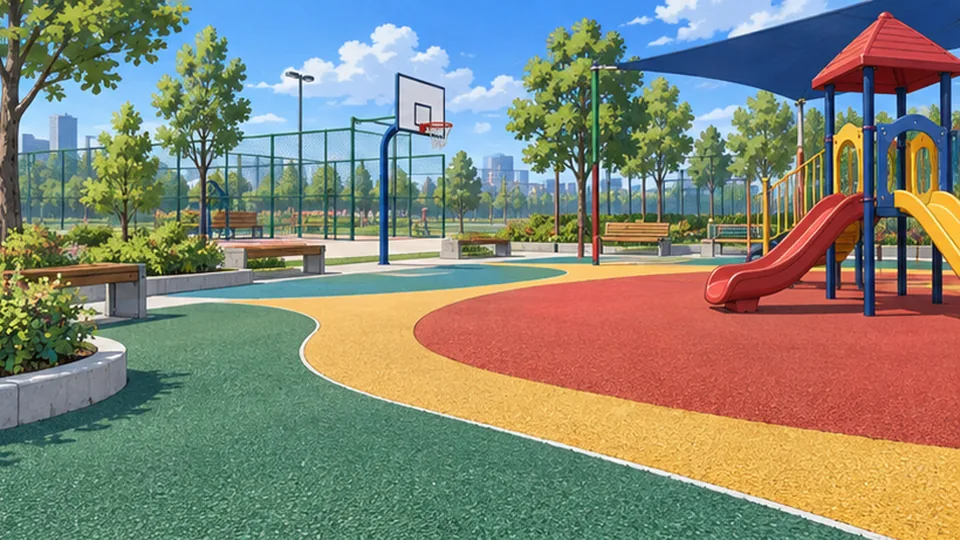
Decide whether you are blending granules or manufacturing them
A running track, hard court, playground fall zone and surrounding walkway have different requirements. In an approved rubber-granule surface, installers commonly combine factory-colored granules with a specified binder. Loose iron oxide added at the site is not a substitute for buying the correct granule color. Melos’s product system illustrates the use of colored EPDM granules and separate binder recommendations. Granule-system context
FUXIN pigment trials belong with the rubber compounder or coating manufacturer unless the complete surfacing supplier explicitly approves another route. Concrete-pigment dosage guidance cannot select a rubber or polyurethane formulation.
Calculate an installation color blend by granule mass
For a proposed 70:30 blend of two already approved granule colors, weigh the colors separately. This is a visual blend ratio, not the resin ratio.
| Total granules | Color A, 70% | Color B, 30% |
|---|---|---|
| Sample: 2.5 kg | 1.75 kg | 0.75 kg |
| Working batch: 25 kg | 17.5 kg | 7.5 kg |
| Material plan: 100 kg | 70 kg | 30 kg |
Add only the binder quantity specified for the exact granule system. Do not choose a generic binder percentage from another surface. Keep the approved granule grading and the base/wearing-layer arrangement; changing them can affect much more than appearance.
For factory pigment trials, distinguish phr from percent of compound
Rubber formulas often use phr: parts by mass per 100 parts rubber. GUME’s technical glossary defines that basis against the base polymer. Rubber formulation basis
If a compounder has already approved a 2 phr pigment candidate and the batch contains 20 kg base rubber, the pigment is 0.4 kg. This is hypothetical arithmetic, not a recommended EPDM dose. If fillers and other ingredients bring the uncolored compound to 40 kg, applying 2% to that whole compound would give 0.8 kg and double the intended amount.
Document polymer, pigment grade, cure system and processing conditions. For a coating formulation expressed in mass percent rather than phr, use that coating’s declared denominator instead. Pigment identity and compatibility need manufacturer confirmation before production.
Make a representative bonded sample
- For installation samples, weigh the selected granule colors and use the approved resin components and mixing method. Keep all materials within the supplier’s storage and moisture conditions.
- For compound development, make an uncolored control and the approved pigment candidate through the actual mixing, curing and granulating route. Do not judge only uncured rubber.
- Prepare surface panels with the specified substrate and layer construction. Label material lots and actual quantities.
- Compare cured color and distribution; inspect for uncoated granules, soft areas, foam and loose particles.
- Run the surfacing system’s required performance checks. Sports behavior, slip, drainage and playground impact attenuation need appropriate system evidence rather than a pigment-only report.
Treat protective performance as a separate approval
CPSC’s current playground handbook addresses protective surfacing and impact attenuation. A color or a granule blend cannot establish the correct protective thickness or critical fall performance. Playground surfacing guidance
| Finding | Check before altering the color recipe |
|---|---|
| Granules shed | Binder coverage, cure and compatibility |
| Surface yellows | Binder exposure behavior |
| Patchy shade | Blend weighing and finishing consistency |
| Surface feels soft or sticky | Component ratio and cure conditions |
| Protective surface is damaged | Qualified inspection before continued use |
Avoid a cosmetic sealer or extra powder as an improvised repair. Record the accepted granule blend and retain a bonded sample for replacement work. Send FUXIN the actual polymer or coating formulation basis, processing route and required tests when requesting a manufacturer-led pigment evaluation.
Technical references
- Melos: EPDM granules and binder references
- GUME: Rubber compound and phr glossary
- CPSC: Public Playground Safety Handbook
- STOCKMEIER: Sports and leisure systems
Independent technical guidance used for this application overview. These references are not FUXIN project case studies or a substitute for a grade-specific technical data sheet.