
How to Choose Iron Oxide Pigments for Cement Mortar
Selecting suitable iron oxide pigments for cement mortar is essential for achieving consistent color, reliable material performance, and long-term durability. These inorganic pigments are widely used in decorative mortars, masonry joints, cement renders, architectural finishes, and other cement-based applications.
However, pigment selection involves more than choosing the desired color. Alkali resistance, tinting strength, particle characteristics, dosage accuracy, and compatibility with cementitious materials must all be considered.
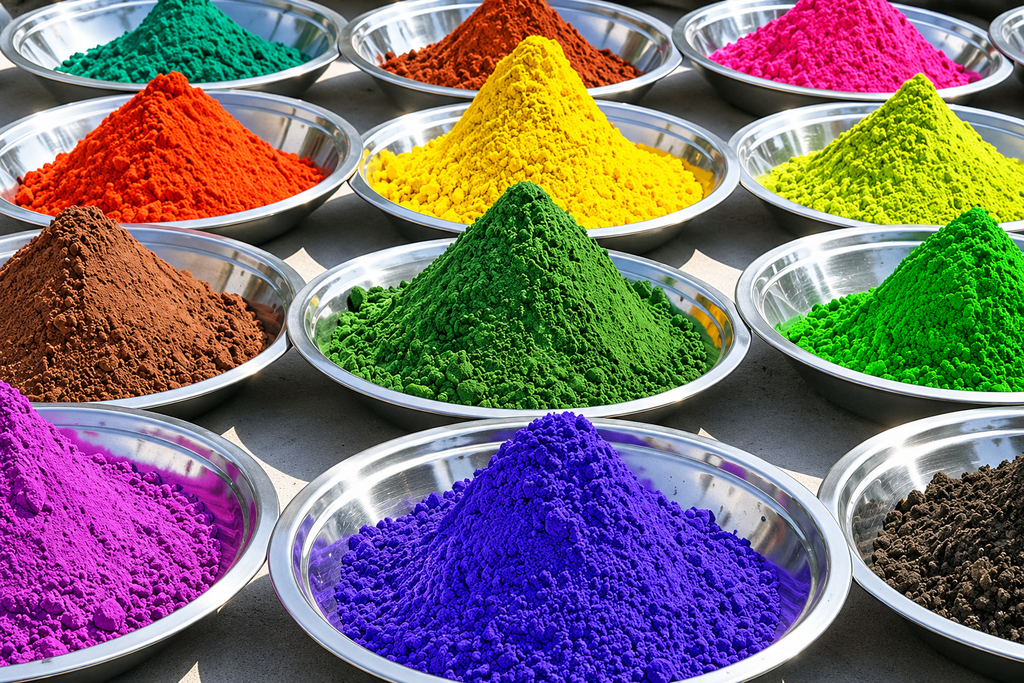
1. Select Pigments According to Color Requirements
Iron oxide pigments are available in several common shades, including red, yellow, black, and brown.
Each pigment provides different coloring characteristics and decorative possibilities.
Red Iron Oxide
Commonly used in decorative cement mortar, masonry joints, and architectural finishes requiring stable red or terracotta shades.
Yellow Iron Oxide
Suitable for warm-colored mortar, decorative rendering, and light-colored architectural surfaces.
Black Iron Oxide
Used to produce gray, charcoal, and dark-colored mortar finishes.
Brown Iron Oxide
Frequently selected for natural earth-tone mortar and traditional architectural applications.
The final appearance depends on pigment concentration, cement color, sand characteristics, and curing conditions.
2. Evaluate Alkali Resistance
Cement mortar creates a highly alkaline environment during hydration.
Pigments used in cementitious materials must remain stable under these conditions to maintain their intended color.
Iron oxide pigments generally provide good alkali resistance, making them suitable for many cement-based applications.
However, performance should be verified according to pigment grade and formulation requirements.
For cement and lime-based building materials, EN 12878 provides relevant specifications and testing methods for pigment evaluation.
3. Consider Cement and Sand Characteristics
The natural color of cement significantly influences the appearance of pigmented mortar.
White cement generally produces brighter colors, while gray cement tends to reduce color saturation.
Sand also affects the finished appearance, particularly in mortar applications where aggregate particles remain visible.
Changes in sand color, grading, or moisture content may produce differences between batches.
For consistent results, manufacturers should maintain stable raw material sources and standardized mixture proportions.
4. Determine the Correct Pigment Dosage
Pigment dosage directly affects color intensity, material consumption, and production consistency.
For many decorative cement mortar formulations, an initial evaluation range of approximately 2–5% of cement weight may be suitable.
However, the appropriate dosage depends on pigment tinting strength, cement composition, target shade, and application requirements.
The required pigment quantity can be calculated as follows:
Pigment Weight (kg) = Cement Weight (kg) × Pigment Dosage (%) ÷ 100
For example, a mortar mixture containing 50 kg of cement at a 3% pigment dosage requires:
50 × 3% = 1.5 kg of pigment
This calculation is illustrative. For cement-lime mortars or proprietary dry mixes, the dosage basis should follow the approved formulation and applicable specifications.
Excessive pigment addition does not necessarily produce proportional improvements in color intensity.
5. Evaluate Pigment Dispersion Performance
Uniform pigment dispersion is essential for achieving consistent mortar color.
Poor dispersion may cause pigment streaks, concentrated color spots, and irregular surface appearance.
To improve distribution:
- Use pigments with suitable dispersibility.
- Measure pigment quantities accurately.
- Maintain consistent mixing sequences.
- Use appropriate mechanical mixing equipment.
- Prevent excessive moisture exposure during storage.
Depending on the formulation, pre-blending pigments with dry cementitious materials may improve initial distribution.
Mixing procedures should be verified through production trials.
6. Consider Weather Resistance and Durability
Mortar used in exterior applications is exposed to sunlight, moisture, temperature variations, and atmospheric contaminants.
Iron oxide pigments generally provide good lightfastness and weather resistance.
Nevertheless, the long-term appearance of colored mortar depends on more than pigment stability.
Binder composition, surface porosity, water penetration, and efflorescence may influence the visible color.
Appropriate mortar formulation, curing, and moisture management are therefore necessary to maintain consistent appearance.
7. Verify Pigment Quality Before Production
Technical evaluation should be completed before introducing a new pigment into large-scale mortar production.
Important quality-control parameters include:
- Color shade and batch consistency
- Tinting strength
- Alkali stability
- Particle size distribution
- Moisture content
- Dispersion performance
- Compatibility with the mortar formulation
Representative test panels should be prepared using the intended cement, sand, pigment dosage, and curing conditions.
Samples should be evaluated after reaching a comparable drying and curing condition.
This process helps identify color variations and material compatibility problems before commercial production.
Conclusion
Choosing suitable iron oxide pigments for cement mortar requires a systematic evaluation of color characteristics, alkali resistance, dosage, dispersion behavior, and material compatibility.
Although iron oxide pigments generally provide stable coloring performance, the final appearance of mortar also depends on cement composition, sand characteristics, mixing procedures, and curing conditions.
By selecting appropriate pigment grades and maintaining standardized production controls, manufacturers can improve color consistency, reduce material waste, and achieve reliable results in decorative and architectural mortar applications.https://fuxinironoxide.com/
