
What Is the Difference Between Iron Oxide Red 130 and 190?
Iron oxide red is a widely used inorganic pigment in construction materials, industrial coatings, colored asphalt, and other manufacturing applications. Among its commercial grades, Iron Oxide Red 130 and 190 are two commonly available options.
Although both pigments are primarily composed of iron(III) oxide (Fe₂O₃), they can produce different red shades and visual effects. Understanding these differences helps manufacturers select the appropriate pigment for their specific color requirements.
1. Color Difference Between Iron Oxide Red 130 and 190
The most noticeable difference between these two grades is their color appearance.
Iron Oxide Red 130
Grade 130 is commonly marketed as a bright or medium red shade. It is suitable for applications requiring a relatively clear and balanced red appearance.
Iron Oxide Red 190
Grade 190 is commonly associated with a deeper, darker red shade. Depending on the manufacturer, it may have a cooler or slightly bluish-red undertone.
The actual color difference should always be confirmed using the manufacturer’s color chart and physical samples.
2. Comparison of Iron Oxide Red 130 and 190
| Comparison | Iron Oxide Red 130 | Iron Oxide Red 190 |
|---|---|---|
| Chemical composition | Fe₂O₃ | Fe₂O₃ |
| Color appearance | Bright or medium red | Deep or darker red |
| Color undertone | Generally balanced red | May appear cooler or bluish |
| Main characteristic | Clear red appearance | Rich, deep red appearance |
| Typical applications | Concrete, paving, coatings | Concrete, paving, coatings |
| Pigment type | Synthetic inorganic pigment | Synthetic inorganic pigment |
These descriptions represent common commercial conventions rather than universal grade specifications.
3. Are Their Chemical Properties Different?
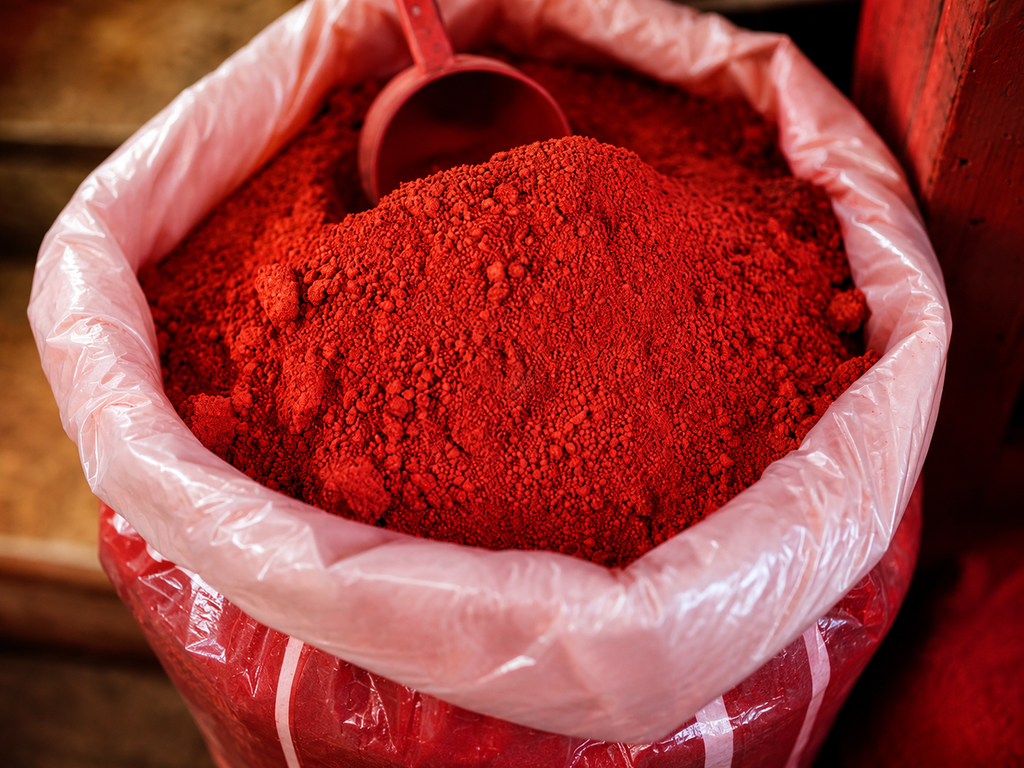
Both grades generally belong to the synthetic iron oxide red pigment family and are identified as Pigment Red 101 (CI 77491).
Their primary chemical composition is the same, but differences in manufacturing conditions, particle characteristics, and pigment structure can influence color development and application performance.
Other technical parameters, such as Fe₂O₃ content, oil absorption, moisture, particle size, and tinting strength, should be evaluated using the individual product’s technical data sheet.
4. Applications of Iron Oxide Red 130 and 190
Both grades can be used in a variety of construction and industrial materials.
- Colored Concrete: Used in concrete blocks, paving tiles, and decorative cement products.
- Colored Asphalt: Helps produce red pavement surfaces when incorporated into a suitable colored asphalt formulation.
- Industrial Coatings: Provides red coloration for compatible coating systems.
- Architectural Materials: Supports customized colors in decorative construction products.
The final color depends not only on pigment grade but also on dosage, binder composition, aggregate color, and production conditions.
5. How to Choose Between Grade 130 and 190
The selection should begin with the desired finished color rather than the model number alone.
Choose Grade 130 when a brighter, more balanced red appearance is required. Consider Grade 190 when a deeper and darker red shade is preferred.
Before large-scale production, manufacturers should conduct small-scale color tests using the actual base material and formulation.
Comparing physical samples under consistent lighting conditions is particularly important for projects requiring strict color matching.
Conclusion
The main difference between Iron Oxide Red 130 and 190 is generally their color shade rather than their basic chemical composition.
Grade 130 is commonly associated with a brighter red appearance, while Grade 190 is often used for deeper red tones.
For reliable results, buyers should evaluate actual color samples, technical specifications, and application compatibility before selecting a pigment grade.
